
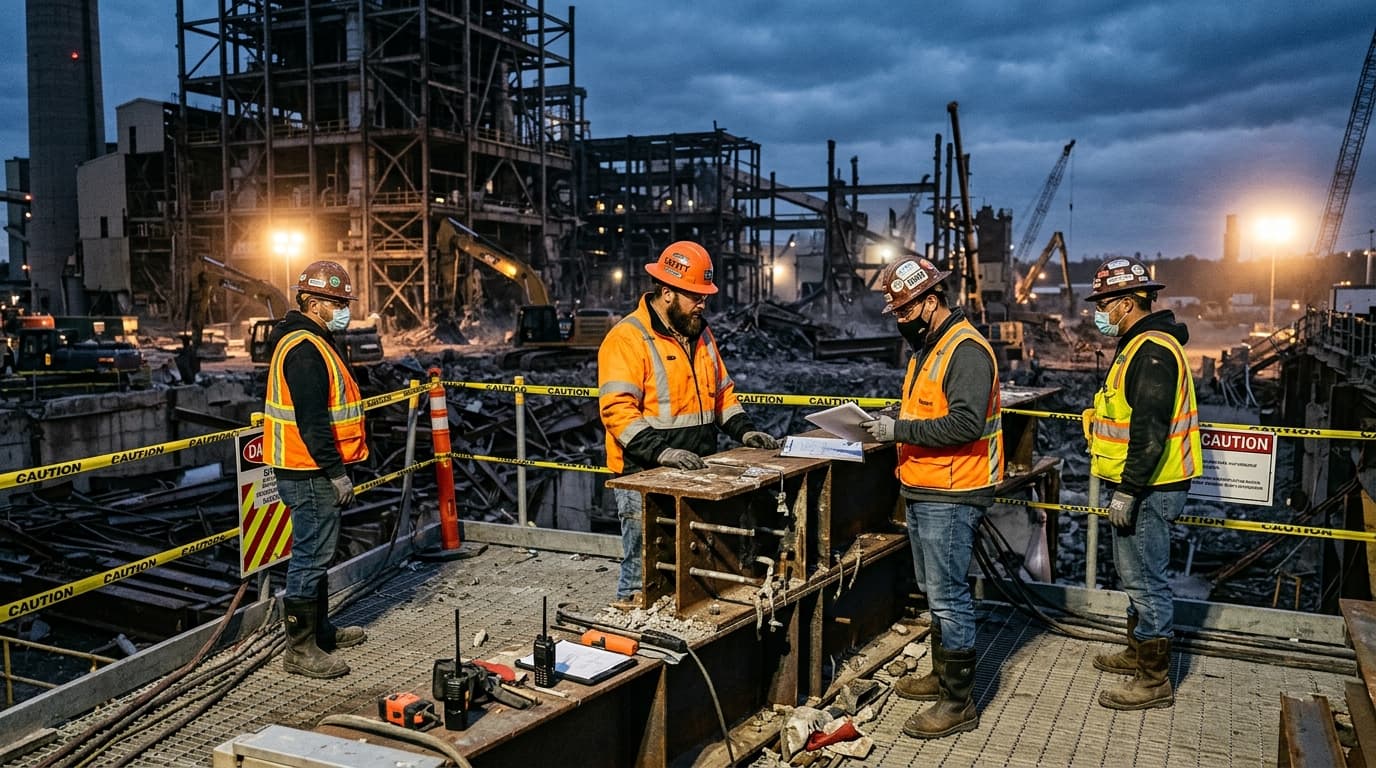
Demolition Safety & Recovery Planning
The hazard set on a damaged site is wider than on a planned demolition, and it changes as the work proceeds.
NO DEMOLITION WITHOUT A PLAN.
Emergency conditions compress every schedule. They do not remove a single control. Before equipment moves, the hazard set is identified, written down and assigned an owner.
POSITION
Speed matters. Safety is non-negotiable.
An emergency changes the schedule, the access and the amount of unknown structure on a site. It does not change the standard the work is held to.
Recovery sites carry hazards that a planned demolition does not: structures that have already failed, utilities of unknown status, emergency crews still working and residents returning before an area is cleared.
HAZARD SET
What We Assess on Every Recovery Site
Unstable structures
Remaining capacity is unknown until it is assessed. Exclusion zones are set from the collapse radius, not the property line.
Partial collapses
A structure that has already failed once continues to redistribute load. Movement is monitored throughout the work.
Exposed concrete
Fractured slabs and spalled columns hide reinforcement condition and shed material without warning.
Exposed steel
Deformed and tensioned members release energy when cut. Sequence and cut location are decided in advance.
Electrical systems
Nothing is assumed de-energized. Isolation is verified with the utility and confirmed at the point of work.
Underground utilities
Gas, water, sewer and communications are located and marked before excavation or heavy tracking.
Restricted spaces
Narrow corridors and dense urban sites limit machine selection, escape routes and rescue access.
Hazardous materials
Suspect materials are handled as hazardous until testing says otherwise, and are segregated from general debris.
Heavy machinery
Swing radius, ground bearing and haul routes are planned so equipment and people never share the same space.
Emergency personnel
Response teams often remain on site. Work is coordinated so demolition never obstructs an active response.
Civilian populations
People return to damaged neighborhoods before they are declared safe. Perimeters, signage and dust control are treated as public protection.
Environmental controls
Airborne dust, noise, vibration and runoff are continuously monitored and suppressed to protect surrounding ecosystems and communities.
PLANNING DISCIPLINE
The Plan Is the Deliverable Before the Demolition Is
Each authorized structure gets a written sequence: what comes down, in what order, with what equipment, from which position, into which exclusion zone, and where the material goes.
That document is what allows an emergency schedule to be compressed safely. Without it, speed is just exposure.
- Before mobilization
- Written demolition plan
- During work
- Movement monitoring
- Perimeter
- Collapse-radius exclusion
- Coordination
- Utilities & emergency services
Colombia Emergency Recovery & Reconstruction Initiative